
By Alex Kraus and Cole Pancake
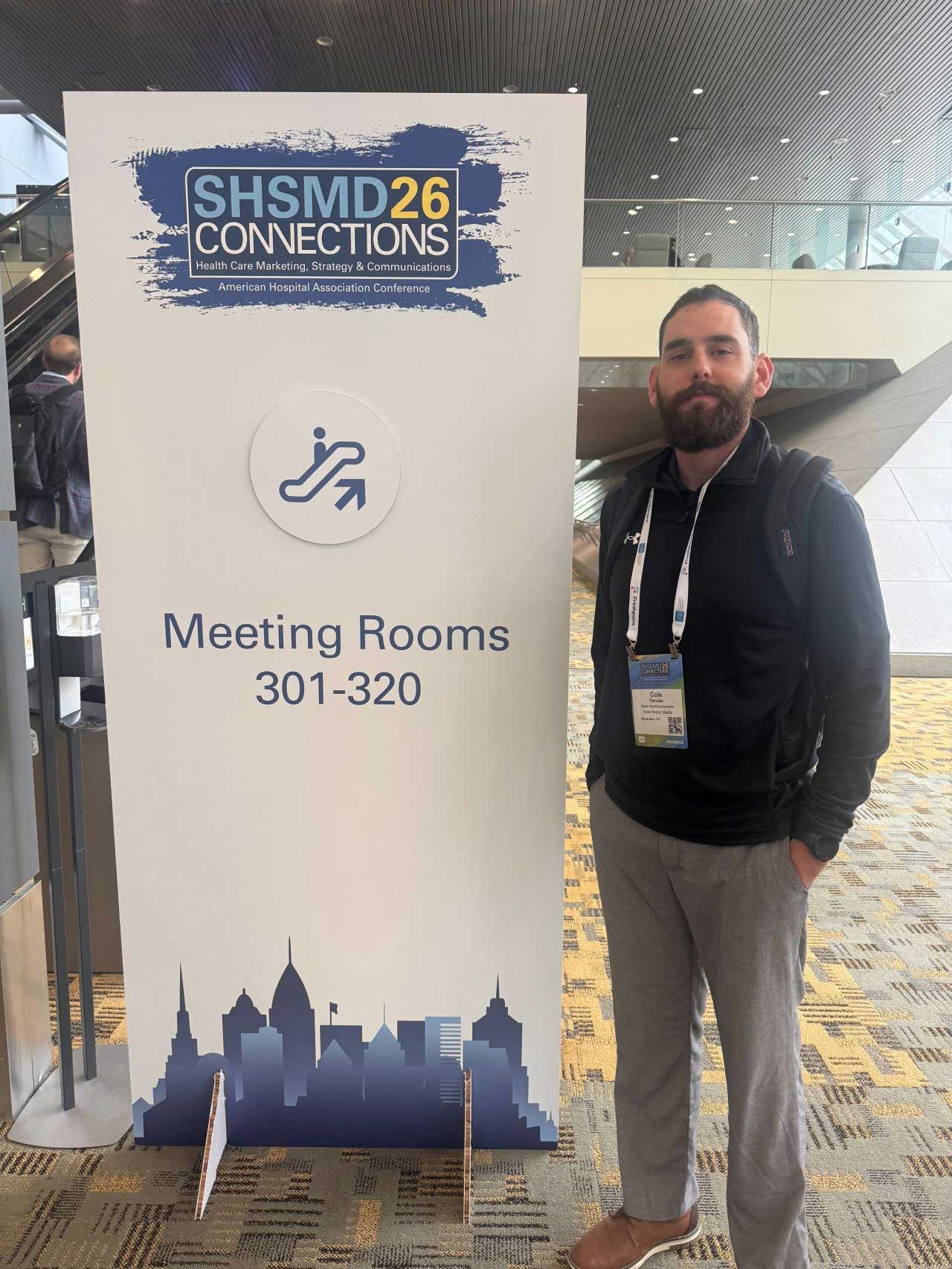
In late September, the two of us spent three days in Baltimore at SHSMD Connections 2026, the annual conference of the Society for Health Care Strategy & Market Development.
Healthcare is a big part of our work, and the ground is moving. Privacy rules limit what can be tracked, budgets are tight, and patients have started asking AI tools where to go.
We came home with four ideas. Most of them apply well beyond healthcare.
1. AI is helping people pick providers
By the end of 2025, one in three U.S. adults had used an AI chatbot for health information, double the share a year earlier, according to Rock Health’s consumer survey.
One line from the AI search session stuck with us: AI doesn’t search, it recommends. It reads everything published about you and only recommends what it’s confident about. The speakers’ argument was that AI gains that confidence when your website, Google listing, reviews, third-party sites and forums like Reddit all tell the same story, and that you’re less likely to come up when they don’t.
Here’s how we’d boil it down:
- Your basic facts (name, address, phone, hours, services) are correct.
- You have a steady flow of recent reviews, and someone answers them.
- Sources AI already trusts, like press and professional organizations, mention you.
- Your website has pages that answer the questions people actually ask.
- Those facts match, word for word, across every directory and platform.
Nobody can promise an AI mention, and anyone who does is guessing. But you can get a quick read on whether you come up in about ten minutes. Ask ChatGPT, Gemini and Perplexity the question your customer would ask, word for word, and see who comes up. We started by running the test on ourselves.
If the answers are missing or wrong, work in this order: listings first, then a steady flow of reviews, then the content on your site.
2. Tracking real outcomes, safely
Hospitals have a measurement problem. Privacy rules limit what can be shared with ad platforms, so many campaigns end up learning from page visits and form fills when the result that matters is a patient who showed up.
Virtua Health and Freshpaint, a healthcare privacy and tracking company, showed how Virtua is working through it. They started together in 2024. Year one built a privacy-safe foundation, and year two is about connecting marketing to real patient outcomes. Their roadmap has five stages:
1. Set the compliance foundation and the vision, moving from risk reduction to responsible growth.
2. Measure patient activity through the health record, so everyone works from one view of the patient journey.
3. Send those outcomes back to the ad platforms, so campaigns optimize toward business results instead of stand-in metrics.
4. Test which campaigns create the most immediate value.
5. Optimize and scale.
The line from their deck we keep repeating: “Privacy is not the end of measurement. It is the foundation that makes more credible measurement possible.” Their advice was to start with one focused pilot tied to a service line that matters, and to bring stakeholders like compliance, legal, IT and finance in early.
As an agency, we can help with this process by making sure our UTMs (the tags on a link that tell analytics where a visit came from) and campaign names are clean and consistent. A Johns Hopkins workshop at the conference called consistent naming and UTMs the foundation of accurate campaign tracking, without which ROI numbers can’t be trusted. We agree.
3. Write the brief in one sentence
Growth came up in almost every session. Bigger budgets did not. Endeavor Management’s session, drawing on SHSMD and industry survey data, put the median healthcare marketing budget at 0.43% of net patient revenue for 2025–2026, down from 0.51% in 2022–2023. That’s about $800,000 less for every $1 billion in net patient revenue.
One of their slides, written for in-house marketing teams, put it bluntly: “You can’t operate as a growth engine if the organization sees you as a service desk.”
When money is tight, the brief matters more. The Unlock Health and Geisinger session gave us a formula we’re putting to work:
Get [who] to [do what] by [how].
It makes everyone name the audience and the action before anyone picks a format. It also gives you a way to tell, afterward, whether the work did its job.
Endeavor’s advice for marketing teams that want a real seat in growth planning follows the same logic. Start with the organization’s growth priorities, decide what marketing’s role is in each one, and bring benchmarks that tie the budget to expected outcomes.
4. Brand and performance work better together
The best-known research on this is Les Binet and Peter Field’s The Long and the Short of It, published by the IPA. Looking at 996 campaigns from the IPA’s effectiveness databank, they found that short-term sales activation produces quick lifts that fade, while emotional brand building keeps growing for years. Their rule of thumb was about 60% of spend on brand and 40% on activation. The exact mix varies by category, but the direction holds. Even the Virtua measurement session listed it among its closing takeaways: preserve the role of trust and brand.
Unlock Health’s research showed what that means for creative. When people describe an authentic company, the top answer is original (37%), ahead of transparent (25%). In their research, caring, reliable and friendly are table stakes. Being distinctive, welcoming and convenient is where a brand can stand out.
The session’s example of courage was Macmillan Cancer Support’s “Whatever It Takes” film from 2021. It’s worth a few minutes of your time.
What we’re doing with it
Here’s where we plan to start with our clients:
- AI visibility checks. We ask the major AI apps what your customers ask, log where you’re missing or wrong, and work on the basics: listings, reviews and content.
- One-sentence briefs, so every project starts with who, what and how.
- Brand and performance plans that keep an always-on brand layer running with measurable campaigns underneath it.
- Clean tracking, so results connect back to real outcomes.
If you’d like to see how your organization shows up when people ask AI for a recommendation, get in touch.
Thanks to SHSMD for a great conference! Session materials are posted on SHSMD’s website.
Inner Action Media is a marketing and advertising agency in Morgantown, WV. We help businesses and organizations connect their target audience with powerful brand stories, data-driven marketing, high-impact creative, and media strategies that accelerate real growth.